From cost to competitive advantage: why governance, risk and compliance now pay
- News
- Reports

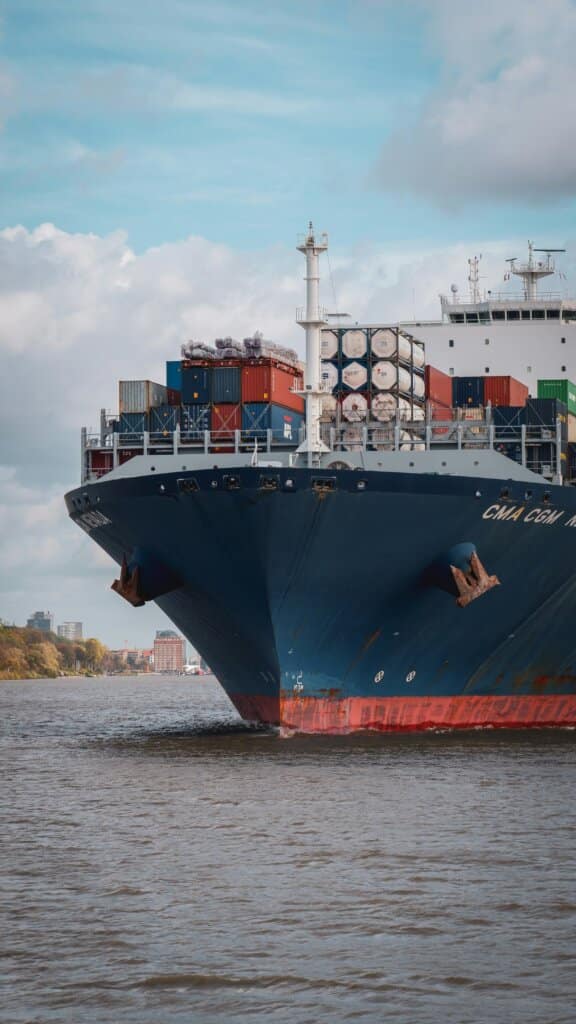
The past seventy years have been the most prosperous in human history, with real income per person growing fourfold since 1950. Progress on this scale was built on a foundation of stable institutions, which created the conditions for economic growth. Those conditions are now weakening. Geopolitical fragmentation, climate and nature disruption, fast technological change, and declining public trust are making the world more volatile and harder to govern.
In our report, Investing in governance, risk, and compliance, we look at what this means for companies and why managing risk well is critical for their businesses.
Two kinds of risk
For companies, the consequence of the changed environment is a world with more risks (and opportunities).
The first is the risk the world poses to the company: These risks come from the systems a company depends on but does not control, including global trade, its supply network, the financial system, and a predictable climate. These are risks such as supply-chain failure, energy crises, and financial instability etc.. An example of this is Russia’s cut to European gas in 2022, which sent power prices up tenfold at their peak and forced governments to commit EUR 651bn to shielding households and industry.
The second is the risk the company poses to the world: These risks come from how a company runs its own business, such as risks to its workers, its supply chain, and the environment etc. Work accidents and work-related disease, for example, kill close to three million people per year. As of 2022, an estimated 28 million people were held in forced labor.
From cost to competitive advantage
Governance, risk, and compliance, or GRC, is how a company deals with those risks and keeps its conduct and operations safe, compliant, and resilient. For many companies, it has been treated as a cost rather than a source of value. This is now changing, as failure to manage risks costs more for companies.
A company today depends on more suppliers, customers, counterparties, and systems than ever, and any one of them can fail and take part of the business down with it. Even relatively localized failures can cascade across entire supply networks and cause significant operational and financial damage. These risks are already materializing. Supply-chain disruptions have risen sharply in recent years, up 38% in 2025 compared to the year before, while new trade restrictions reached record highs between 2023 and 2025, with more than 2,500 imposed worldwide in the first ten months of 2025 alone.

"Strong risk management is no longer a cost of doing business. It is a competitive advantage."
– Johan Pietilä Holmner, Partner at Summa
The cost of managing risk has decreased meaningfully. Technology, most recently AI, has driven much of this improvement – and we believe there is a lot more to come. Work that once took analysts weeks now takes seconds, and the signals that precede a failure can be caught early rather than pieced together after the fact. Tools that only the largest firms could once afford are now getting within reach of thousands of companies, which can use them to manage both the risks they face and the harm they cause.
With this change in cost and efficacy, managing risk has become a source of value in its own right. The same visibility that lets a company see and control its risks also shows it where it is losing money. It shows the company the waste, the inefficiency, and the fraud it could not see before. For the largest and most exposed companies, the decision to manage risk seriously was made years ago. What is new is that the same logic now reaches all companies.
The size of the opportunity
The European GRC tech market is worth EUR 12bn today and is expected to reach EUR 23bn by 2030, growing 14% a year and representing more than EUR 100bn in investor value.
Within this market, we focus on five solution areas:




Building on what works
We have invested here before. EcoOnline, a former Summa portfolio company, helped a large multinational facilities manager increase hazard and near-miss reporting by 140% while reducing time lost to injuries by 18%. At a Norwegian automotive retailer, the same platform identified 450 chemicals on site, replaced 140 toxic ones, and made more than 100 redundant.
Infobric, another former Summa portfolio company, which we exited in 2025, improves the management of construction workers and equipment by providing end-to-end construction software solutions. It develops smart tools that simplify the complexity of the construction ecosystem, empowering more than 450,000 users to gain better control, work more safely and efficiently, and ensure stronger compliance.
Peoplesafe, which we acquired in January 2026, provides safety devices and apps connected to a 24/7 alarm receiving centre (ARC), helping protect more than 375,000 lone and frontline workers across the UK and North America. Its services in the UK, enable faster emergency response, with help typically reaching workers around twice as quickly as through public emergency services.
Our vision
We invest in companies that provide GRC solutions because we want a world that is more resilient, safe, trustworthy, and sustainable – enabling the stable conditions prosperity depends on.
Download our latest report to see how companies can turn risk management into a competitive advantage and where we see the largest opportunities.
The Summa Summarum newsletter
Sign up to our newsletter
Latest readings
News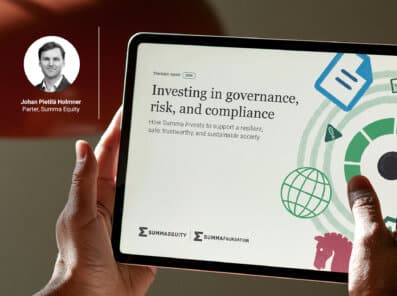
From cost to competitive advantage: why governance, risk and compliance now pay
Read more
From tasks to transformation: how our portfolio is putting AI to work for impact
Read more
Why Summa is breaking ground in the HEC-Dow Jones-ranking
Read more
From the edge of the map: perspectives from the Summa Summit 2026
Read more
Close to home: reflections from Summa’s Annual Investor Meeting 2026
Read more